Click here to download this Case Note by Erica Bedford & Tom Mason.
Erica Bedford and Tom Mason have secured a significant victory in the Court of Appeal in Turner v Coupland Cavendish Limited [2026] EWCA Civ 1204 successfully overturning Sweeting J’s decision and establishing important new authority on the limits of a costs judge's jurisdiction and the role of the cash account in solicitor and own client assessments under the Solicitors Act 1974.
Background:
The Appeal concerned the important issue of whether Part 18 Requests within Solicitor Act assessments are an appropriate vehicle from which to compel a solicitor to disclose whether it had received commissions or other financial benefits from after-the-event (ATE) insurance providers. This issue is important as it reflects a somewhat unwelcome trend that has developed in respect of challenges to deductions from damages taken by firms acting for personal injury clients. However, the implications for the Judgment are much wider as the Court addressed, authoritatively for the first time, the fundamental principles of the scope and confines of matters which can be resolved within the Solicitors Act assessment jurisdiction.
The Respondent, Mr Stephen Turner, had instructed Coupland Cavendish Limited under a conditional fee agreement to pursue a personal injury claim. Following settlement and delivery of the solicitors' statutory bill, Mr Turner's new legal representatives issued a Part 18 Request designed to obtain information on whether the solicitors had received any direct or indirect secret commission from the ATE insurer.
Costs Judge Rowley (now the Senior Costs Judge) refused to order the solicitors to answer the Request, not least because the Part 18s were not before him, but, also, importantly on jurisdictional grounds. In a wide ranging and sweeping decision by Sweeting J reversed that decision on appeal to the High Court, holding that there was jurisdiction within Solicitor Act assessments to make such an order.
The solicitors, represented by Erica Bedford and Tom Mason and instructed by Nick McDonnell of Kain Knight (North & Midlands) Ltd, appealed to the Court of Appeal.
The Court of Appeal Decision:
The Court of Appeal, comprising Lord Justice Lewison, Lord Justice Phillips, and Lady Justice Andrews, sitting with Costs Judge Whalan as assessor, unanimously allowed the appeal on all grounds, in what is a resounding victory for the solicitors.
In a judgment handed down by Lady Justice Andrews, the Court held at [§100] that:
Significance:
Lady Justice Andrews expressly recognised that the appeal raised "important questions about the role of the cash account in the assessment of costs; a client's ability to interrogate that account; the impact of a solicitor's fiduciary duties on a costs assessment; and the correct threshold for the application of CPR Part 18".
The decision is expected to have far-reaching implications across the costs litigation sector in two respects:
First, the judgment closes the door on an increasingly widespread practice of using Part 18 Requests in Solicitor Act assessments as a vehicle for compelling investigations into potential secret commissions on ATE insurance policies, a practice the Court found lacked a proper jurisdictional basis. In this respect, the Court of Appeal found at [§19] that the prior authority of Raubenheimer v Slater and Gordon UK Ltd [2022] EWHC 1091 (QB) was wrongly decided as being per incuriam and ought no longer be followed.
Second, the judgment provides much needed clarity on the scope and nature of the types of arguments that can be determined within the confines of a Solicitor Act assessment. In this respect, the Court of Appeal have confirmed the principles in Lisa Jones v Richard Slade & Co [2022] EWHC 1964 (QB) that general matters engaging with equitable remedies other than resolving whether an item was reasonably incurred are issues which fall outside the jurisdiction of a costs judge on a s.70 assessment.
Practical Implications:
The implications for practitioners are substantial.
Turner removes a significant source of cost and uncertainty for solicitors’ firms across the jurisdiction. The practice using Part 18 Requests as a back-door mechanism to investigate ATE commissions has been a recent irritant for firms conducting high-volume personal injury work. That door is now firmly closed: Turner stands as definitive authority that no response is required.
However, the old adage of where one door closes another window opens remains apt: the warning given at [§5 and 11] indicates the level of sympathy a Court is likely to have toward applications brought on the correct jurisdictional footing where a solicitor has refused to provide the relevant information. Whether the firms acting for clients in this area will take up the mantle of proceeding via applications for an account pursuant to Part 40 or Part 67 remains to be seen. To this extent, solicitors’ firms will still be well advised to treat any requests for such information with a degree of seriousness.
The Judgment is commended to all those practising in the specialist area of Solicitor Act assessments and those in management positions within solicitors’ firms as relevant reading.
Comment:
Commenting on the outcome, Erica Bedford said:
"This is a landmark decision that brings much-needed clarity to an area of costs law that has been the subject of significant satellite litigation in recent years. The judgment provides clear guidance on the proper scope of the cash account in costs assessments and the limits of the costs judge's jurisdiction under section 70(7) of the Solicitors Act 1974, both areas in respect of which there was a lack of authoritative guidance. In Turner, the Court of Appeal has definitively established that Solicitor Act assessments are concerned with solicitor's bill and the certification of what is due in respect of it: they are not a vehicle for conducting wide-ranging inquiries into solicitors' fiduciary obligations or alleged secret commissions. The judgment will therefore bring significant clarity in respect of what can and cannot be determined within the confines of a Solicitor Act assessment.”
Tom Mason added:
“The Court's finding that the Raubenheimer decision was wrongly decided is particularly significant, as it removes the principal authority on which claimants' representatives had relied to pursue disclosure of ATE commissions within a Solicitor Act assessment."
Online Seminar:
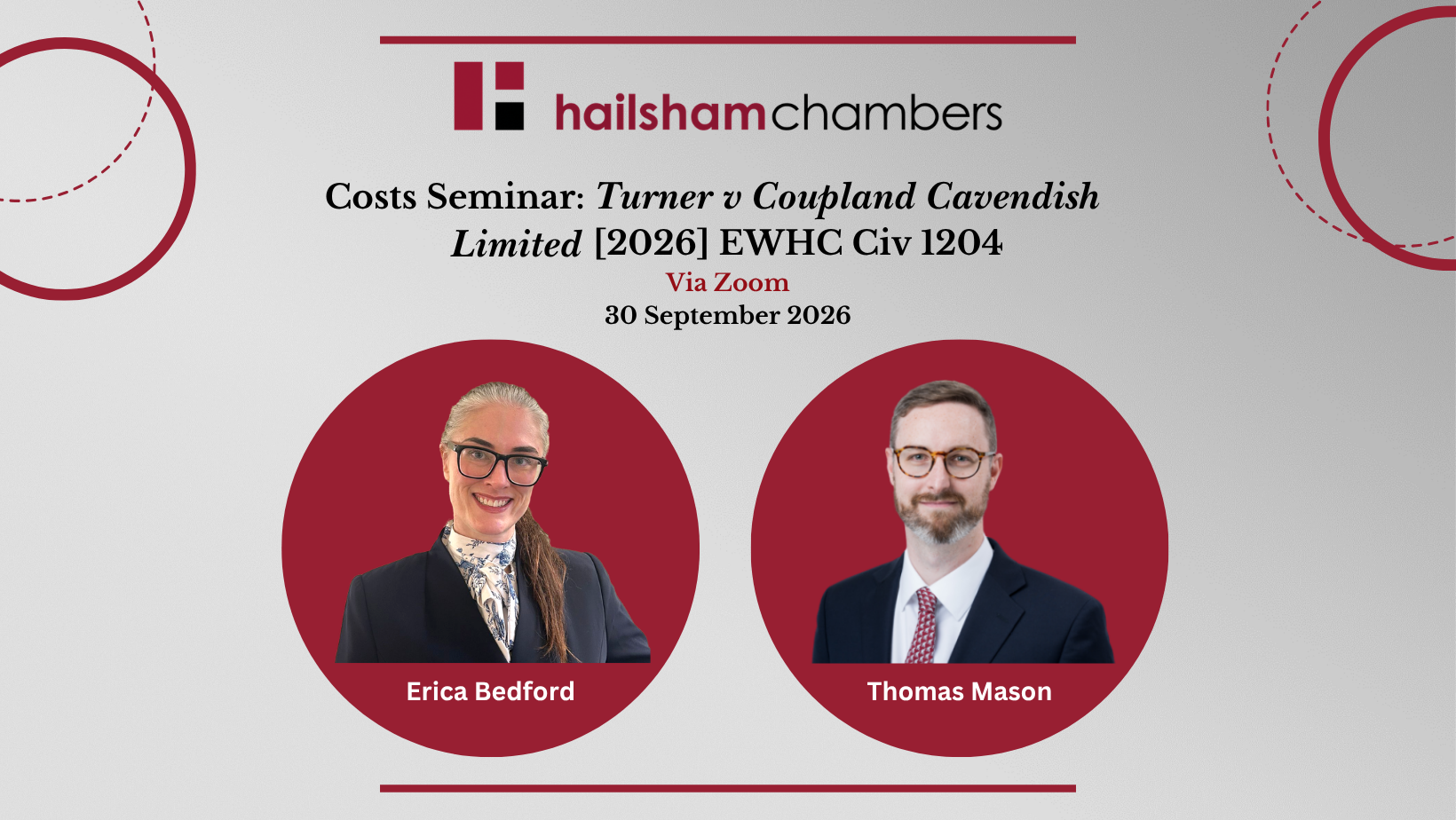
On Wednesday, 30 September, the Turner team delivered an online seminar to discuss the full legal and practical ramifications of the decision.
The recording of this online seminar is available to watch here.
This Case Note is available to download as a PDF below.
___________________________________________________________________
To receive Hailsham Chambers event updates, articles, and podcast notifications, please sign up to our Mailing List.